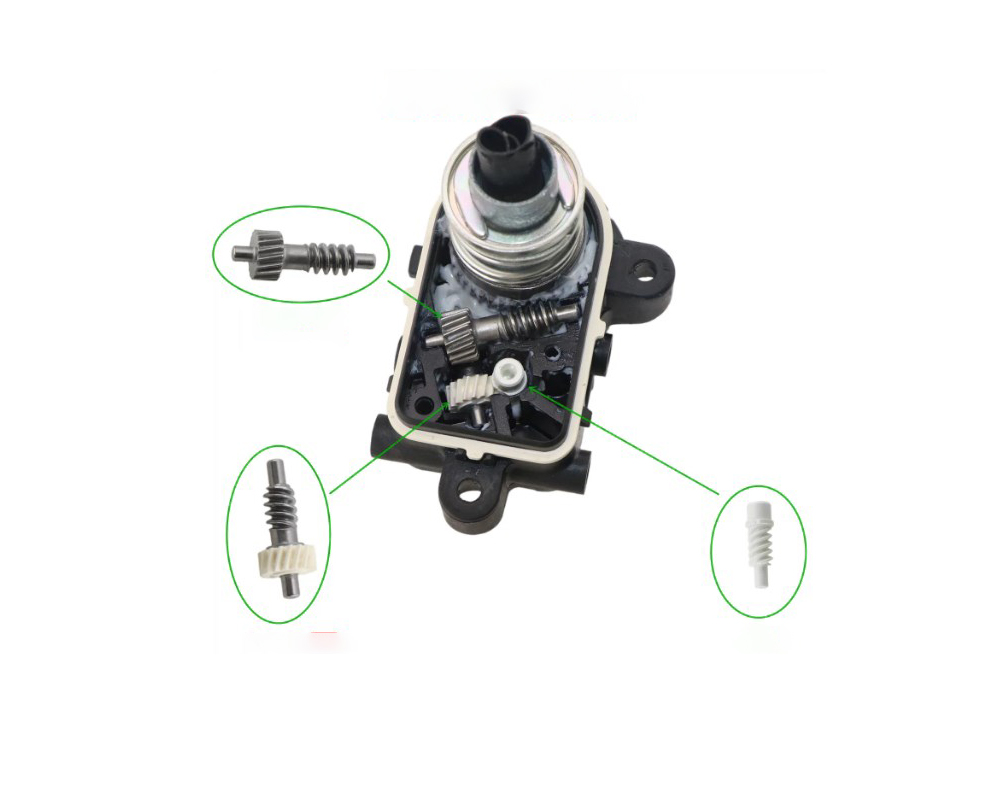
The gear train is a critical mechanical transmission component in an electrically folding exterior mirror system. It converts motor speed and torque into the mechanical output required to fold and unfold the mirror assembly. The design and performance of the gear train directly affect operating stability, folding consistency, noise and vibration characteristics, and overall service life.
The mirror folding mechanism uses a worm gear and multi-stage planetary gear reduction system. The high-speed, low-torque output of the DC motor is converted into lower-speed, higher-torque mechanical output through successive stages of gear reduction.
This speed reduction and torque multiplication enable controlled angular movement and reliable reciprocating operation of the mirror folding mechanism. Compared with belt or flexible transmission systems, a compact gear train provides efficient power transmission and precise mechanical control within the limited space available inside an exterior mirror housing.
The gear train is designed to provide consistent torque transmission, controlled backlash, and stable operation throughout repeated folding cycles.
AZGIANT uses different materials according to the load, wear and strength requirements of individual gear components.
Modified POM is used for intermediate transmission gears. It provides a low coefficient of friction, good dimensional stability, fatigue resistance and inherent self-lubricating characteristics. These properties help reduce gear-tooth wear and support reliable operation over repeated operating cycles.
Glass-reinforced nylon is used for higher-load output gears. Its high tensile strength, impact resistance and improved low-temperature toughness help the gears withstand transient loads caused by frozen mirrors, external impact or forced operation.
High-strength alloy components are used for worm shafts and primary drive components where greater hardness, wear resistance and structural rigidity are required. These properties help maintain reliable torque transmission under high rotational speeds and operating loads.
AZGIANT gear sets are pre-lubricated with high-temperature, silicone-based damping grease.
The lubricant forms a protective film on the gear teeth, helping reduce friction, control gear noise and vibration, and maintain smooth gear engagement. It is designed to remain stable across a wide operating temperature range of -40°C to 120°C, with low volatility, oxidation resistance and compatibility with commonly used engineering plastics.
Proper and durable lubrication helps reduce dry friction, tooth-surface wear, pitting and gear seizure, all of which can contribute to premature failure of mirror folding mechanisms.
Automotive exterior mirrors are exposed to a wide range of environmental and operating conditions that can affect gear durability and performance.
High temperatures may contribute to thermal deformation and material aging, while low temperatures can reduce material toughness and increase the risk of impact-related damage.
Rainwater, humidity and condensation can contribute to corrosion, contamination and changes in gear engagement conditions.
Dust and other foreign particles can enter the mechanism and accelerate gear-tooth wear, potentially affecting transmission efficiency and operating consistency.
Forced manual folding, frozen mirror assemblies and other abnormal operating conditions can generate excessive torque and impact loads, increasing the risk of gear-tooth damage or structural failure.
AZGIANT gears are designed with aging resistance, toughness and corrosion resistance in mind to support reliable operation in the demanding outdoor environment experienced by automotive exterior mirrors.
5. Importance of Gear Transmission in Electric Mirror Folding Systems

Genuine guarantee
Original丨Non-destructive straight mounting
Self-supporting storage
Global Warehousing丨Faster transportation
Insurance protection
Goods logistics fully insured
Worry-Free Return
Seven-day quality problem refund